You know that AI is changing the technology industry. But when you start exploring career options, the advice can become confusing: learn SQL, master Python, move to cloud computing, build with large language models, or jump straight into AI agents. What should you actually learn first?
For many students and working professionals in India, the real question is Data Engineering vs Generative AI: which path matches my current skills and future goals? And where does Agentic AI fit into the picture?
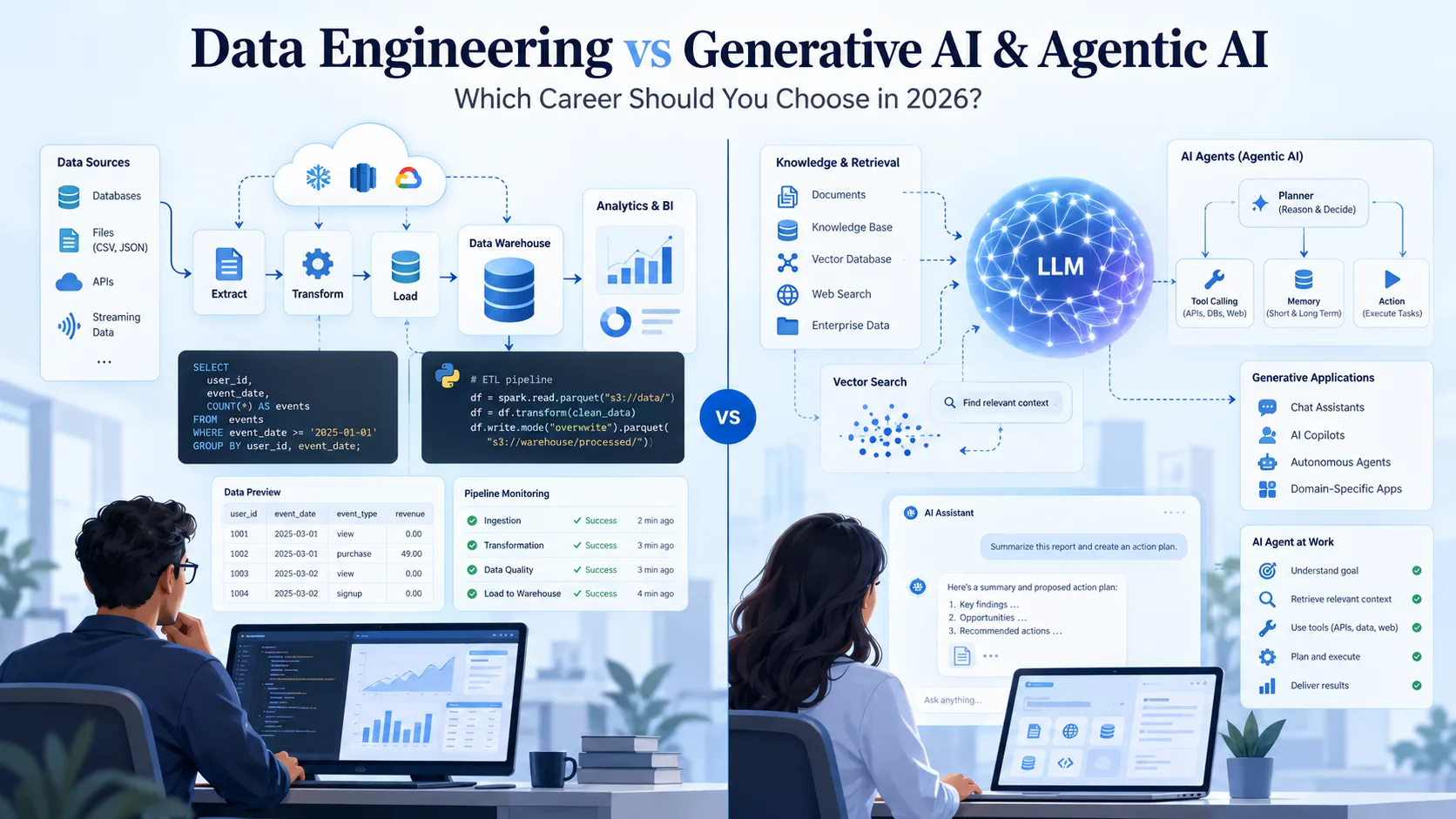
There is no universal winner. Data engineers build the systems that make information usable. Generative AI engineers build applications that create, summarise and reason over content. Agentic AI developers go further by connecting models to tools and controlled workflows. Modern businesses may need all three.
This guide explains the differences, skills, projects, career opportunities, salaries and practical learning roadmaps, so you can make an informed decision before investing in a program.
1. Why choosing a technology career feels confusing in 2026
AI tools are becoming more capable, but employers still need people who can solve real business problems. A chatbot demonstration is not the same as a reliable application; a dashboard is only as useful as the data flowing into it.
India’s hiring data reflects this focus on applied skills. A foundit report published in January 2026 recorded about 2.9 lakh AI job postings in 2025 and projected 32% growth in AI job demand in 2026. That is a forecast, not a guarantee of individual job opportunities. The report also identified Python, SQL and data engineering among important supporting skills for AI roles.
The implication is simple: don’t select a career just because its name is trending. Look at the day-to-day work, required foundations and types of projects you would enjoy building.
2. What is Data Engineering? Practical examples and responsibilities
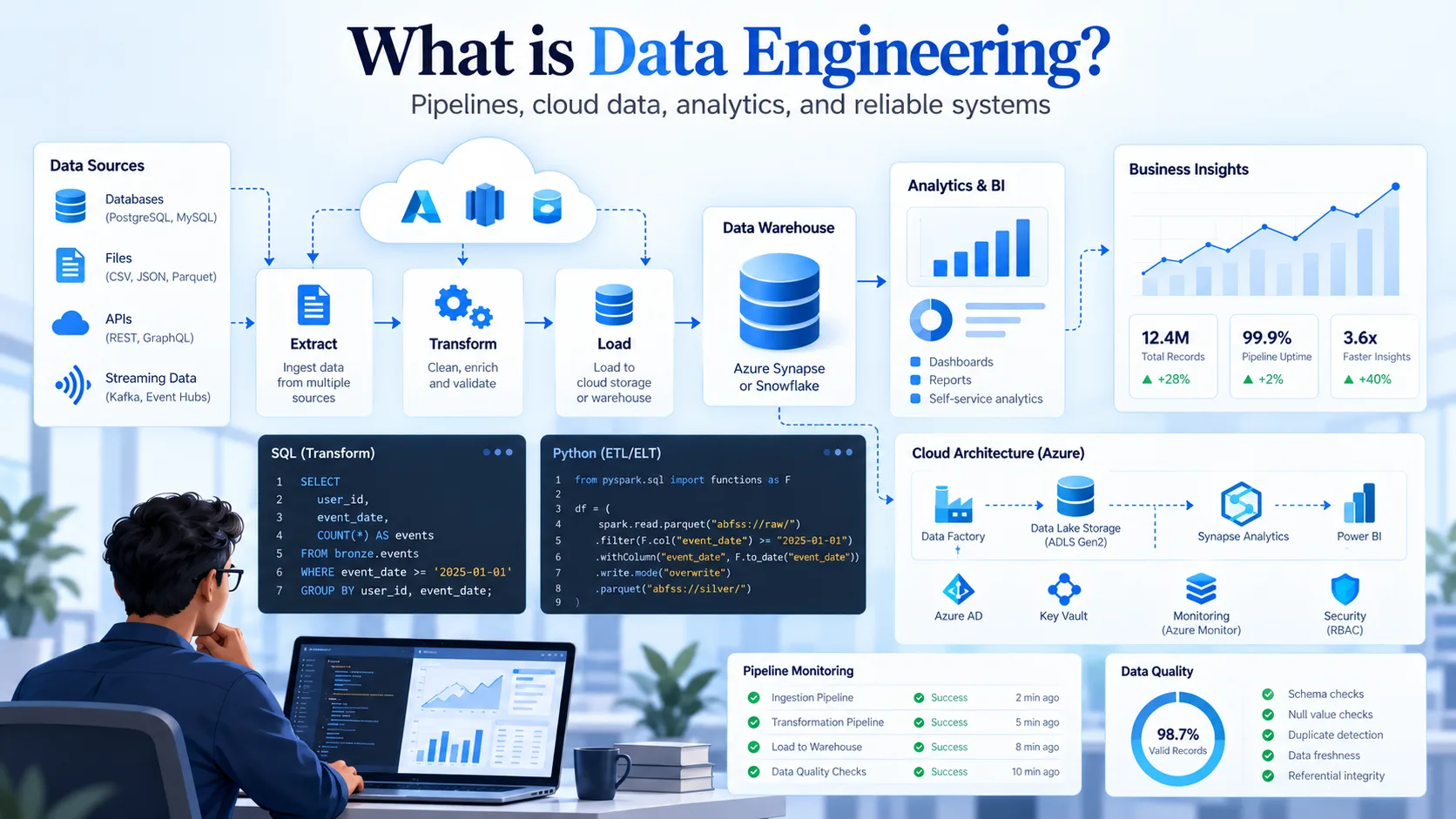
Data Engineering is the process of collecting, transforming, organising and delivering data so analysts, applications and AI systems can use it reliably.
Imagine an online retailer with orders arriving from its website, payments platform and warehouse. These systems store information differently. A data engineer builds a pipeline that brings the records together, removes errors, updates them on schedule and makes them available for reporting or AI applications.
Common responsibilities include:
- Writing SQL queries and Python scripts to process data.
- Building ETL/ELT pipelines that move and transform information.
- Working with cloud platforms such as Microsoft Azure.
- Using Azure Data Factory, Databricks, PySpark and Delta Lake.
- Monitoring failures, data quality, access controls and performance.
- Preparing trusted datasets for dashboards, reporting and AI use cases.
A practical portfolio project: Build a retail sales pipeline that ingests daily order files, handles duplicates, transforms the data in Databricks and serves clean tables for a Power BI dashboard. Explain how you would recover when a scheduled job fails.
For someone exploring a Data Engineering career in India, this path can be attractive if you enjoy structured problem-solving, databases, cloud systems and building the infrastructure behind digital products. An Azure Data Engineer focuses particularly on Microsoft’s cloud data ecosystem.
3. What are Generative AI and Agentic AI Engineering?
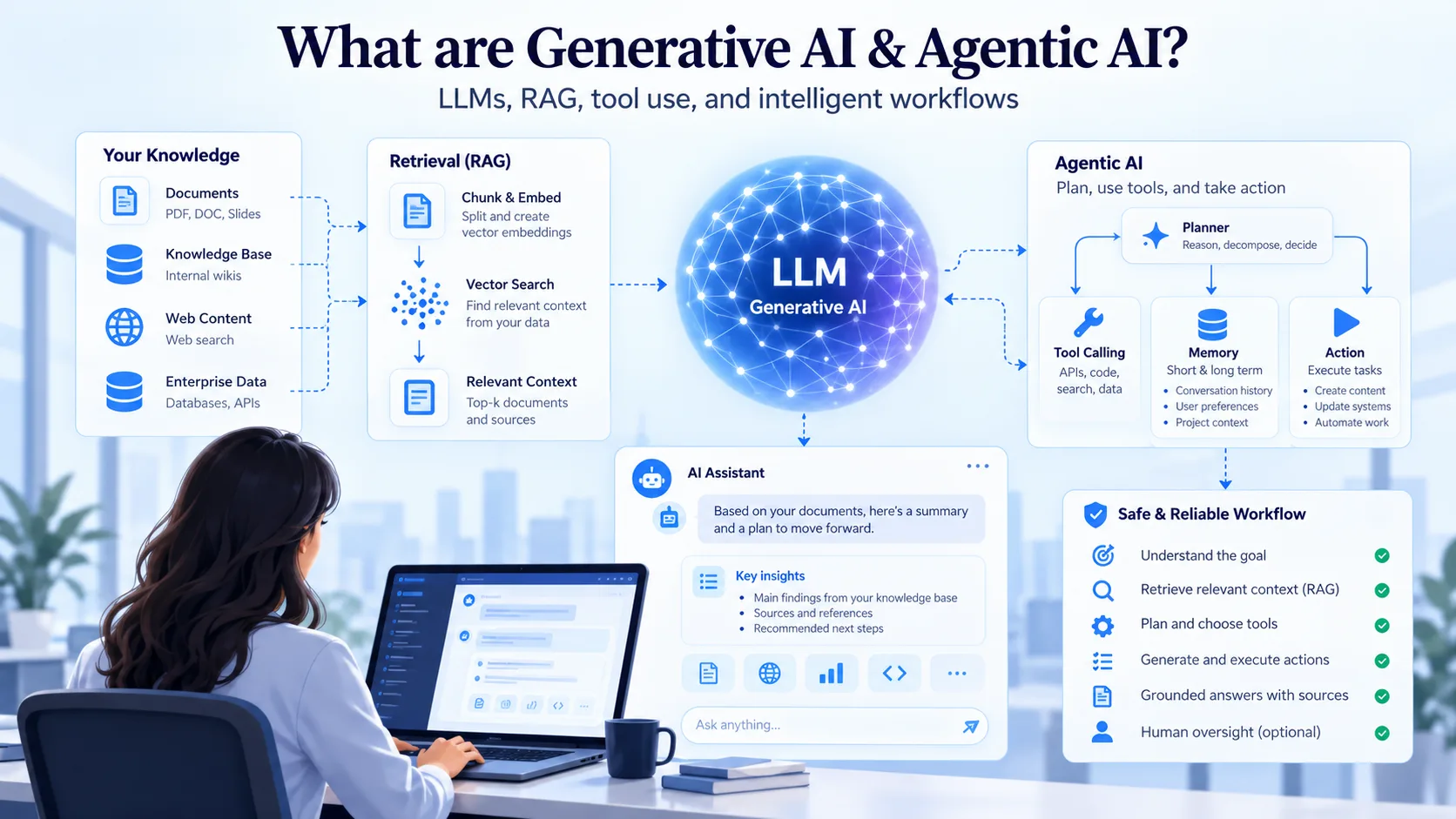
Generative AI refers to systems that produce content such as text, code, summaries or structured answers. A Generative AI Engineer designs the software around these models: prompts, APIs, retrieval, output validation, evaluation, security and deployment.
For example, a company may need an assistant that answers employee questions using its internal HR policies. An engineer could build a retrieval-augmented generation (RAG) system that finds relevant policy passages and generates an answer with source references. The difficult part is making the answer accurate, secure and dependable, not simply connecting a chatbot interface.
Agentic AI adds goal-directed workflows. Instead of only answering a question, an AI application may decide which approved tool to call next, inspect the result and propose an action. An internal support agent, for instance, could retrieve a policy, look up a service ticket and draft a response for a human to approve.
These systems still require boundaries: permissions, validation, error handling, stop conditions and human approval for sensitive actions. Agentic does not mean uncontrolled automation.
Typical skills for this path include Python, APIs, large language models (LLMs), embeddings, vector databases, RAG, LangChain, LangGraph, the Model Context Protocol (MCP), evaluation and cloud deployment.
A practical portfolio project: Build a document-support assistant that cites its sources, refuses unsupported answers, logs failures and uses an approved tool to suggest, but not automatically execute, a ticket update.
If you enjoy software development, experimentation and building intelligent applications, a Generative AI career in India may be worth exploring. But most applied AI roles require stronger programming foundations than social-media tutorials suggest.
4. Data Engineering vs Generative AI vs Agentic AI: Skills and responsibilities compared
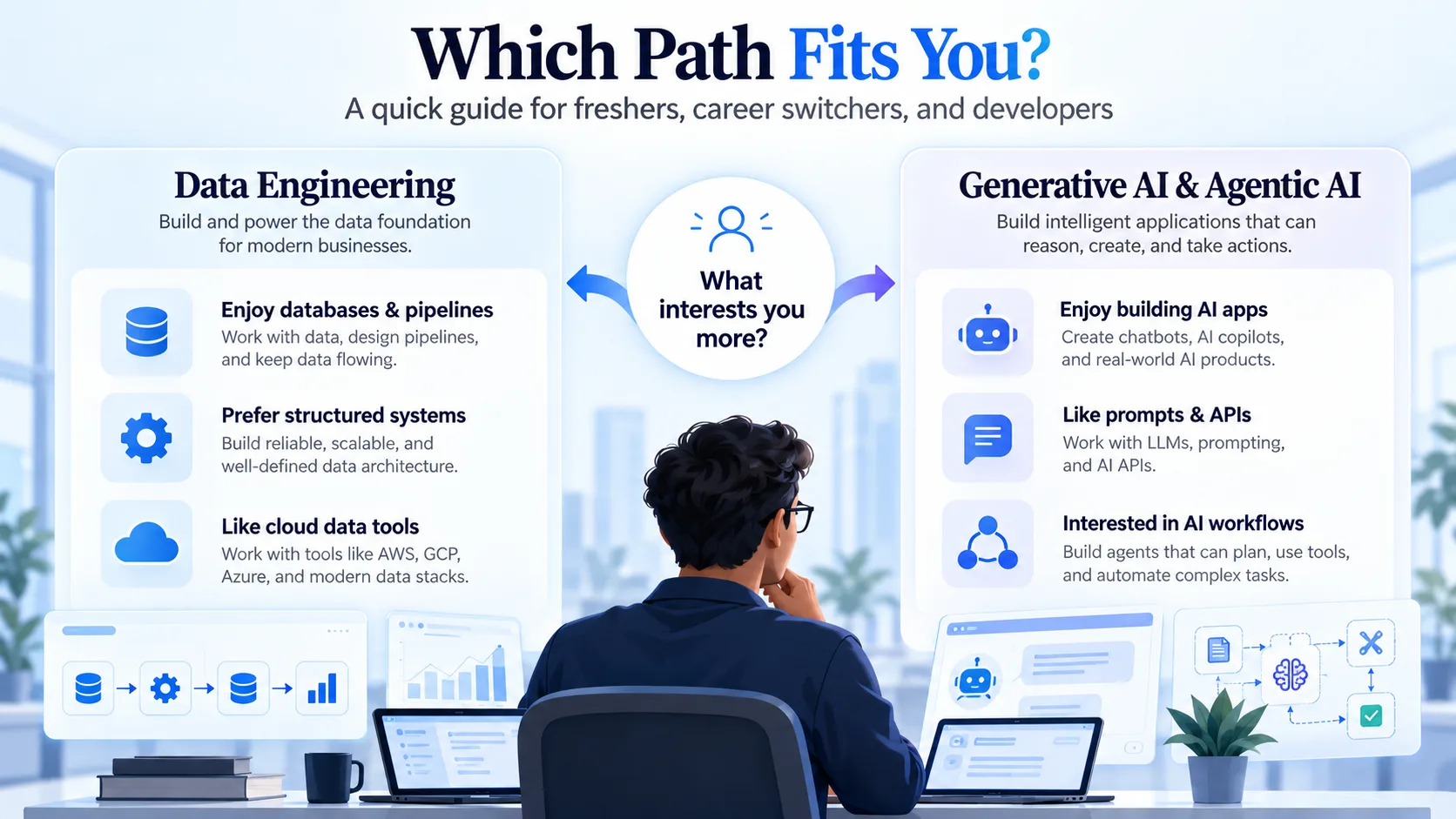
These terms are related, but they are not identical categories. Data Engineering is an established engineering discipline; Generative AI is a technology used in applications; Agentic AI describes systems that can plan and use tools within defined limits.
| Factor | Data Engineering | Generative AI Engineering | Agentic AI Engineering |
|---|---|---|---|
| Main objective | Make data reliable and accessible | Build useful applications with generative models | Build controlled, tool-using AI workflows |
| Core skills | SQL, Python, ETL, Spark, cloud data platforms | Python, APIs, LLMs, RAG, testing | Python, tool calling, orchestration, permissions, evaluation |
| Example project | Automated sales data pipeline | Document Q&A assistant with citations | Support agent that checks tickets and proposes actions |
| Common challenge | Data quality, scalability and pipeline reliability | Accuracy, latency, cost and safety | Tool errors, permissions and workflow reliability |
| Best starting point | Learners building programming and database foundations | Learners comfortable with Python and APIs | Learners who already understand LLM applications |
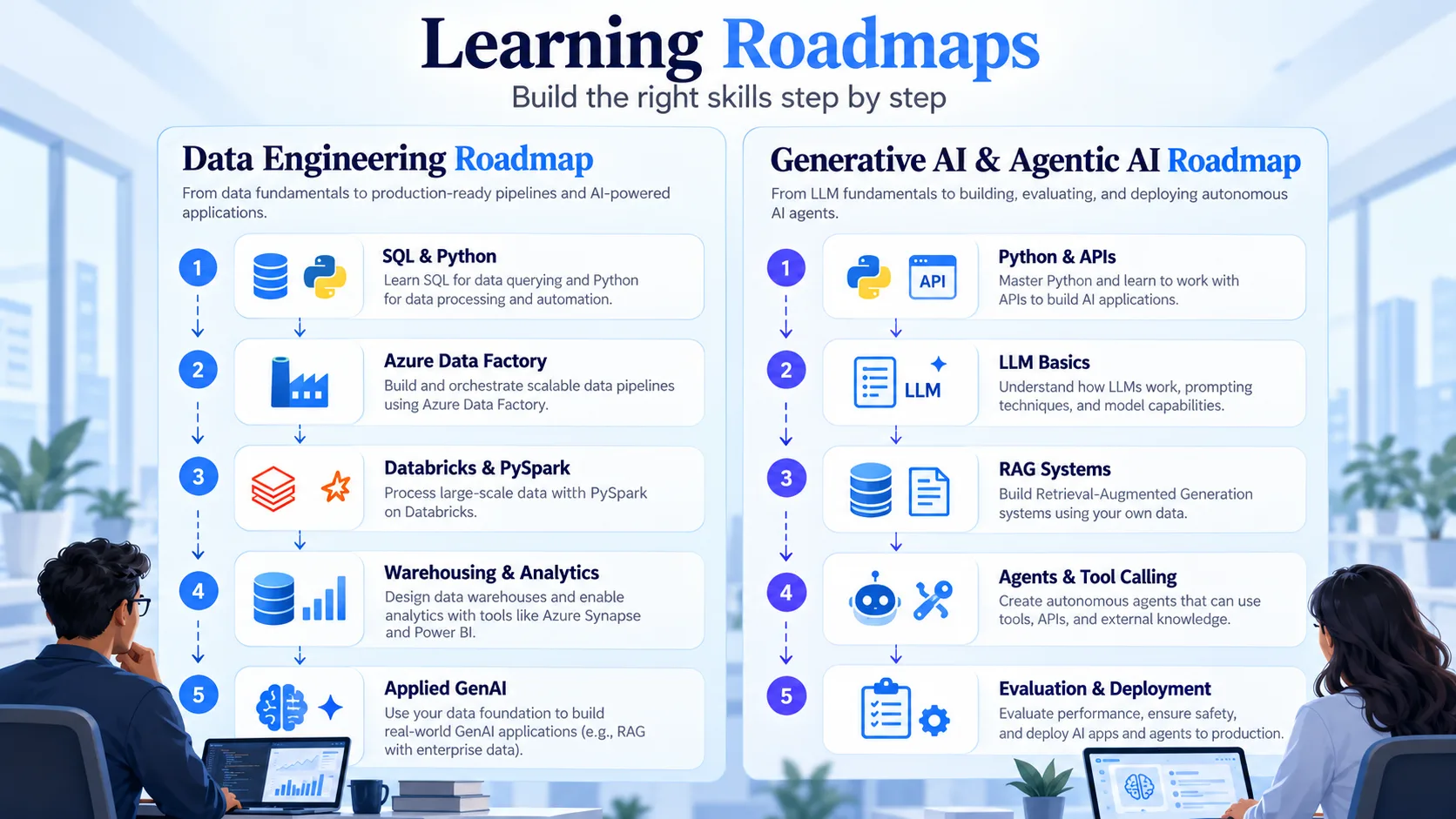
Which is easier for a beginner? A foundational Data Engineering roadmap often offers a more structured entry point because you can progress from SQL and Python to cloud pipelines. Generative AI development is accessible to motivated beginners, but production-grade applications still demand coding, software engineering and testing skills. Agentic AI usually makes more sense after those basics.
The most important insight in Data Engineering vs Generative AI is that these skills can complement each other. Reliable retrieval and AI applications depend on well-prepared, governed data; data products increasingly benefit from applied AI capabilities.
Not sure where to begin? Compare the Data + GenAI Engineer program with the Generative AI & Agentic AI program, or book a free career consultation to discuss your experience and goals before choosing a track.
5. Job opportunities and salary expectations in India
The demand for data and AI skills is real, but job titles vary between employers. Look at each job description instead of assuming every ‘AI Engineer’ or ‘Data Engineer’ position requires the same skills.
Potential Data Engineering roles include Junior Data Engineer, ETL Developer, Azure Data Engineer, Data Operations Engineer and, with experience, Data Platform Engineer. Applied AI roles may include AI Application Developer, Generative AI Engineer, LLM Application Engineer and AI Agent Developer. Some employers combine responsibilities across data, cloud and AI.
For hiring context, a Reuters report from July 2026 noted that AI-related hiring in India’s IT sector grew 16% year on year in June, while overall IT postings declined 3%, citing Naukri’s JobSpeak report. That signals targeted demand, not that every applicant will be hired quickly.
What do these careers pay?
As of 16 October 2026, Indeed’s India salary data listed an average base salary of approximately ₹9.54 lakh per year for Data Engineers, based on 982 reported salaries. Glassdoor’s India estimate for AI Engineers was approximately ₹10 lakh per year in average base pay when reviewed in October 2026.
These are broad, platform-specific averages across different experience levels, not fresher salaries, placement promises or directly comparable samples. There is also no single dependable average for every Agentic AI role, because titles and responsibilities are still evolving. Actual offers depend on your location, previous experience, projects, interviews, company and market conditions.
Career advice: Instead of chasing the highest headline package, assess the skills required for roles you can realistically target over the next 6–12 months. A working project and the ability to explain your design decisions usually provide more convincing evidence than buzzwords on a resume.
6. Which career suits freshers, non-IT graduates and experienced developers?
If you’re a fresher
Start by becoming comfortable with programming and problem-solving. SQL, Python, basic data modelling and Git give you foundations you can demonstrate. Data Engineering may be a sensible first pathway if you enjoy working with data and want a clear sequence of technical skills. You can explore applied GenAI once those foundations are stronger.
If you’re from a non-IT background
A career switch is possible, but it takes practice. Begin with Python basics, SQL queries, file handling and small projects. Avoid courses that assume you can already debug code or work with APIs. Your first milestone should be a working project you can explain confidently, not memorising definitions.
If you’re a software developer
If you already use Python, APIs, Git and cloud services, you may be ready to investigate a Generative AI Engineer roadmap. Learn LLM limitations, build a RAG application, add testing and deployment, then move toward agents with explicit permissions and approval flows.
If you’re an analyst, SQL or MSBI professional
Your existing experience may transfer naturally into Azure data pipelines, warehousing, Microsoft Fabric and Databricks. Moving toward an Azure Data Engineer role can extend skills you already use rather than requiring a completely new starting point.
If you’re working full-time
Choose a learning plan you can sustain. A few hours of consistent coding, project work and review every week beats collecting multiple unfinished courses. Ask training providers about live schedules, recordings, prerequisites and opportunities to practise with real tools.
7. Step-by-step learning roadmaps and portfolio projects
There is no single perfect roadmap. Here are two starting points depending on your background.
Roadmap A: Data Engineering with applied GenAI
- 1
Step 1: Fundamentals. Learn SQL joins, aggregations, Python functions, files and basic cloud concepts. Build a script that validates a CSV dataset.
- 2
Step 2: Data pipelines. Learn Azure Data Factory, storage and incremental loading. Build a repeatable pipeline that can rerun without duplicate records.
- 3
Step 3: Processing and analytics. Work with Databricks, PySpark, Delta Lake, warehousing and Power BI. Explain how raw data becomes dependable business metrics.
- 4
Step 4: Delivery. Add Git, testing, monitoring and basic CI/CD practices. Document failure scenarios and recovery steps.
- 5
Step 5: Applied AI. Explore how cleaned documents and datasets can support retrieval-augmented generation. Build a small application that shows its sources and limitations.
This Data Engineer roadmap leads from core data skills toward practical AI-ready systems.
Roadmap B: Generative AI and Agentic AI applications
- 1
Step 1: Programming. Strengthen Python, REST APIs, JSON, Git and basic software design.
- 2
Step 2: LLM foundations. Learn prompting, model selection, token costs, structured outputs and common failure modes.
- 3
Step 3: RAG systems. Use embeddings and vector search to create an assistant that answers with retrieved evidence. Test unsupported questions.
- 4
Step 4: Agent workflows. Add LangGraph or a similar framework, tool calls, state management, permission checks and human approval.
- 5
Step 5: Evaluate and deploy. Measure quality, latency and cost; add logging and deploy the application to a cloud environment.
A strong portfolio can contain one well-documented end-to-end project rather than ten shallow demos. Show the problem, architecture, data sources, tests, screenshots, limitations and what you would improve next.
8. How J2D Careers helps you build practical, job-relevant skills
Reading a roadmap is useful. Following one with structured practice, mentor feedback and career guidance can make it easier to stay consistent.
At J2D Careers, the Data + GenAI Engineer program covers 200 session hours: 160 hours of Azure Data Engineering and 40 hours of applied GenAI, followed by two additional capstone weeks. It starts with SQL, Python and cloud basics, then progresses through Azure Data Factory, Databricks, PySpark, analytics, delivery and RAG. It is positioned for learners building data engineering foundations and exploring applied AI.
The Generative AI & Agentic AI program offers 108 learning hours, including guided labs and a cloud capstone. It covers LLMs, RAG, LangChain, LangGraph, MCP, tool use, evaluation and deployment. This track is designed primarily for learners who already understand Python and introductory machine learning.
J2D Careers also offers live, mentor-led sessions, real-world projects and career support covering resume preparation, GitHub and LinkedIn profiles, mock interviews and job-search guidance. Placement assistance supports the search process; employment outcomes always depend on individual readiness and hiring decisions.
If you’re considering an AI engineering course in Bangalore or a Data Engineering course in Bangalore, don’t choose based on a certificate alone. Ask what you’ll actually build, what knowledge is expected on day one, how project feedback works and whether the schedule suits your life.
Explore the programs: Data + GenAI Engineer | Generative AI & Agentic AI.
9. Frequently asked questions and your next step
- Is Data Engineering better than Generative AI in 2026?
- Neither is universally better. Data Engineering is a strong fit for people who enjoy cloud systems, pipelines and structured data. Generative AI engineering may suit people who enjoy software development and building LLM-powered applications. Your background and interest matter more than the trendiest title.
- Can I learn Agentic AI without knowing Python?
- You can understand the concepts, but building dependable AI agents usually requires programming, APIs and debugging. Start with Python and basic application development before tackling complex agent workflows.
- Is Data Engineering a good career for non-IT students in India?
- It can be, provided you are willing to develop SQL, Python, data-processing and cloud fundamentals. Build projects, seek feedback and target roles appropriate to your demonstrated experience.
- Do Data Engineers need Generative AI skills?
- Not for every job. But understanding how trusted data, metadata and retrieval support AI applications can broaden your perspective and help you collaborate with AI teams.
- Which J2D Careers program should I choose?
- If you need foundations in SQL, Python and Azure data tools, start by examining Data + GenAI Engineer. If you already know Python and introductory machine learning and want to build LLM applications and agents, explore Generative AI & Agentic AI. The right fit depends on your skill assessment and goals.
- How can I start without choosing the wrong course?
- Write down your current skills, the roles you want to apply for and one project you would enjoy building. Then compare course prerequisites and outcomes, not just the topic names.
Ready to choose a career path that fits you?
Your next step doesn’t have to be an immediate enrollment. Start with a conversation about your experience, learning priorities and career goals. The J2D Careers team can explain program prerequisites, practical projects, batch options and career support so you can make a more confident choice.
Book Your Free Career Roadmap ConsultationLearn the skills. Build the proof. Choose your next move with clarity.